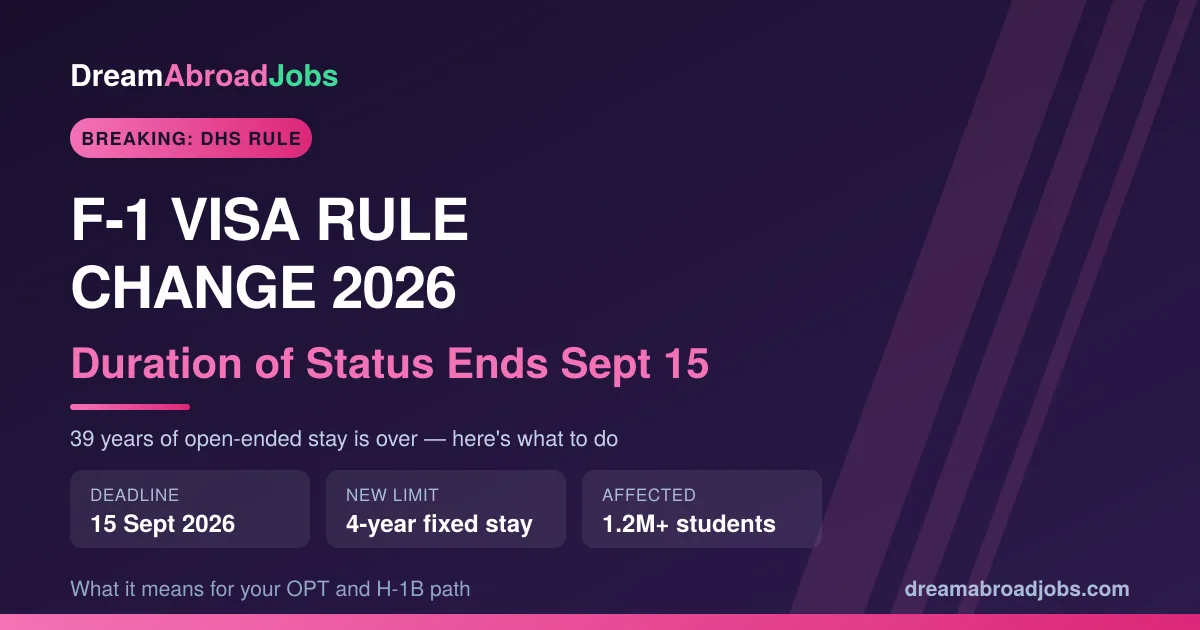
For nearly four decades, an F-1 student visa worked on a simple principle: as long as you stayed enrolled and made normal academic progress, you could remain in the United States without a fixed expiration date on your stay. That system, called Duration of Status (D/S), is ending. Starting 15 September 2026, F-1 and J-1 students will be admitted for a fixed period instead — and if that date passes without action on your part, you can fall out of status without realizing it.
Almost everything published about this so far is written for university international offices and immigration compliance teams. This guide is written for the student — especially if OPT, STEM OPT, or an eventual H-1B is part of your plan.
What's Actually Changing
The Department of Homeland Security published a final rule in the Federal Register on 17 July 2026, eliminating Duration of Status for three nonimmigrant categories: F (academic students), J (exchange visitors), and I (foreign media representatives). It takes effect on 15 September 2026.
Under the old system, your I-94 record simply said "D/S" — no end date, as long as you stayed in status. Under the new system, you'll be admitted for a fixed period tied to the Program End Date on your Form I-20, capped at a maximum of four years, plus a 30-day grace period to enter the country and another 30 days to depart after your program ends. English language program students face a shorter two-year cap.
This is being described by immigration attorneys as the most consequential change to the US student visa system in three decades, and it affects an estimated 1.2 million international students currently in the country.
Why a Fixed Date Actually Matters
Under D/S, your legal status simply followed your enrollment — no separate filing was needed just to remain a student in good standing. Under the new system, your authorized stay has a specific end date (the "Admit Until Date," shown on your I-94). If your program legitimately runs longer than that date allows — a longer PhD, a delayed graduation, an OPT extension — you now need to proactively file Form I-539, Application to Extend/Change Nonimmigrant Status, with USCIS before that date arrives, along with the filing fee.
Missing that filing window isn't a paperwork inconvenience — it can mean falling out of legal status without any single dramatic event triggering it. That's the core practical risk this rule creates that didn't meaningfully exist before.
New Restriction on Changing Majors or Transferring Schools
The rule also adds a new restriction: undergraduate students generally cannot change their major or transfer to a different school during their first year without approval based on "extenuating circumstances." If you're a first-year student reconsidering your program, this is a meaningfully bigger decision under the new rule than it was before.
If You're Already in the US Under D/S
Transition rules apply if you were already admitted under D/S before the effective date, and the specifics depend on your individual timeline — your Program End Date, whether you've filed for OPT or STEM OPT, and when. Some students who timely file for post-completion OPT or STEM OPT by specific deadlines may not need to file a separate extension application immediately, but the safe move is not to assume anything about your own case.
Talk to your Designated School Official (DSO) directly and confirm your specific Admit Until Date and whether any action is required before September 15. This is genuinely one of those situations where a five-minute conversation with your DSO now is worth far more than reading ten generic articles about the rule.
The Part That Actually Matters for Your Career: OPT and the Path to H-1B
If your plan after graduation includes Optional Practical Training (OPT), a STEM OPT extension, or eventually an H-1B sponsorship, here's why this rule change isn't just a compliance detail — it's directly relevant to your job search timeline.
Because your authorized stay now has a hard end date rather than open-ended D/S, the margin for error around your OPT start date, your STEM OPT extension filing, and your eventual H-1B cap-subject filing gets tighter. Under the old system, small delays in paperwork rarely put your ability to stay at risk. Under the new system, a missed filing window can end your authorized stay regardless of your academic or employment standing.
Practical implications if you're job hunting on OPT:
- Know your exact Admit Until Date and calendar backward from it — don't wait until you're close to the deadline to start your I-539 or OPT paperwork
- If your employer is planning to sponsor an H-1B, confirm timelines with them early — the FY2027 H-1B cap has already been reached, which means cap-subject filing windows and timing matter more than ever
- Build in buffer time for USCIS processing delays, which tend to increase whenever a major rule change like this rolls out
If H-1B sponsorship is part of your plan, our guides to the 2026 H-1B fee structure and H-1B alternatives if you're not selected cover the next stage of that path in detail.
What to Do Before September 15
- Find your current I-20 and confirm your Program End Date
- Contact your DSO and ask directly how the new rule applies to your specific timeline
- If you're on or planning OPT/STEM OPT, confirm your filing deadlines don't overlap awkwardly with the rule's effective date
- Set calendar reminders well ahead of any deadline your DSO gives you — not on the deadline itself
- If you're job hunting for after graduation, start earlier than you otherwise would, since USCIS processing timelines are less forgiving under a fixed-date system
Frequently Asked Questions
When does the new F-1 visa rule take effect?
15 September 2026. The rule was published in the Federal Register on 17 July 2026, with a 60-day implementation window.
What is replacing Duration of Status?
A fixed period of admission tied to your I-20 Program End Date, capped at a maximum of four years (two years for English language programs), plus 30-day grace periods for arrival and departure.
Do I need to do anything if I'm already in the US on D/S?
Possibly — it depends on your specific Program End Date and OPT/STEM OPT filing status. Confirm directly with your Designated School Official rather than assuming your situation matches a general description.
Does this affect OPT or STEM OPT?
It affects the surrounding status timeline — your authorized stay now has a hard end date, which makes timely OPT and STEM OPT filing more important than it was under open-ended D/S.
What happens if I miss my extension deadline?
You risk falling out of legal status. Under the new system, this can happen without a single dramatic triggering event — simply by not filing Form I-539 in time.
Confirm Your Own Timeline
Generic explanations of this rule won't tell you your own Admit Until Date — only your DSO and your I-20 can. If your path runs through OPT toward an eventual US job or H-1B sponsorship, treat the next five weeks as planning time, not just reading time.
If you're building toward a US work visa after your studies, our guides on H-1B fees and H-1B alternatives cover what comes after OPT, and you can browse current jobs in the USA to see what employers are hiring for right now.
This guide summarizes the DHS final rule published in the Federal Register and is not legal or immigration advice. Every student's situation differs based on program type, filing history, and individual timeline — confirm your specific status with your Designated School Official or a qualified immigration attorney before the rule takes effect.