If you work in Saudi Arabia, or you are applying for a Saudi job right now, your work permit is no longer just a work permit. Since 2025, every foreign worker in the Kingdom has been sorted into one of three tiers — High-Skilled, Skilled, or Basic — and which tier you land in now affects your wage requirements, your renewal process, and in some cases whether you need to sit an exam before your visa is even issued.
Almost everything written about this change is aimed at HR departments and employers. This guide is written for the worker: how the classification actually works, how to check your own tier, and what to do if it looks wrong.
What actually changed
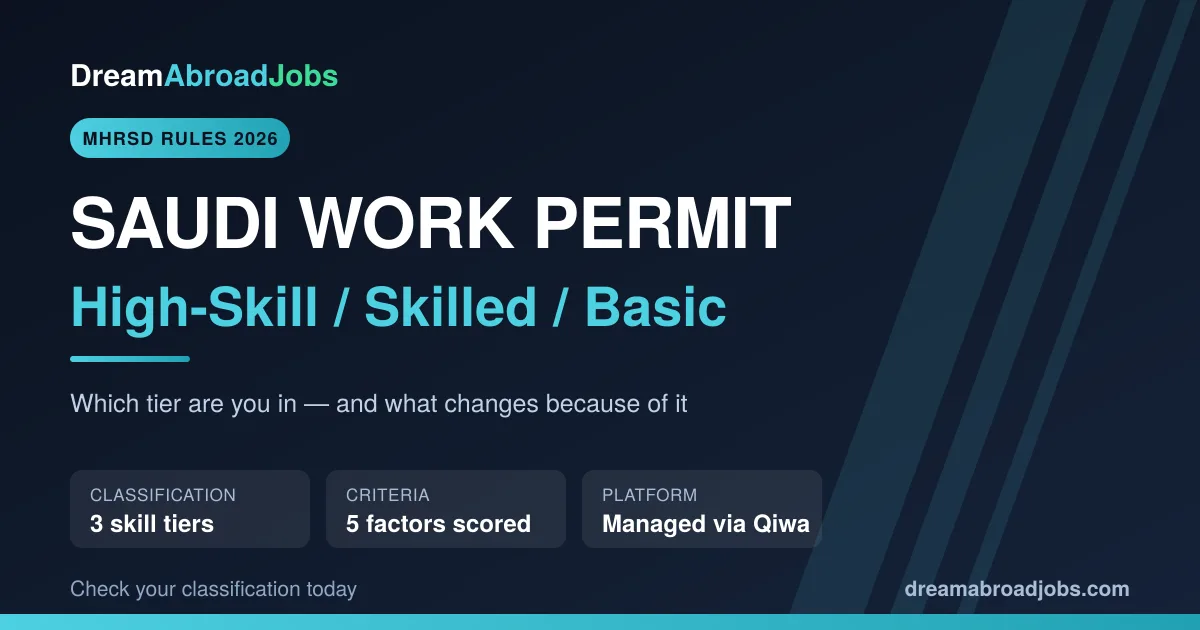
Saudi Arabia's Ministry of Human Resources and Social Development (MHRSD) replaced the old "professional versus non-professional" work permit system with a three-tier structure built on the Saudi Standard Classification of Occupations (SSCO):
- High-Skilled — typically managerial, specialist and technical roles: doctors, engineers, IT specialists, corporate executives
- Skilled — technician and mid-level roles requiring a recognised trade or secondary qualification
- Basic — general labour and support roles
The rollout happened in phases through 2025: reclassification of existing work permits began in June 2025, and every new expatriate work permit issued from August 2025 onward has gone through this system. By 2026 it is fully in force across the workforce, and it is managed entirely through Qiwa, the Ministry's official digital labour platform.
The five official criteria
According to Qiwa's own published guidelines, your tier is decided by five factors:
- Educational qualifications — whether your academic background suits the profession
- Professional experience — years of relevant experience required for that skill level
- Professional skills — accreditation requirements specific to the role
- Remuneration — the wage threshold the Ministry has set for that occupation, which varies by economic activity
- Age — the age range specified for that profession
For the High-Skilled tier specifically, several of these factors are scored under a points system rather than treated as strict pass/fail cut-offs — a strong showing in one area, such as experience, can offset a weaker one elsewhere, such as age. This matters if you feel you narrowly miss one requirement: it is worth checking whether the overall score still qualifies you before assuming you are excluded.
Because wage thresholds are set per occupation and per sector rather than as one fixed number across the board, do not rely on a figure you saw for a different profession. Check your own occupation's threshold directly on Qiwa.
Why this matters even before you have a job offer
This is the part most guides skip, and it is the part that affects Pakistani applicants directly.
Saudi Arabia now runs a Skill Verification Program (SVP) alongside the classification system, and it operates on two tracks:
- External track — new recruits are tested in their home country, including Pakistan, India, Bangladesh and Sri Lanka, before a Saudi work visa is issued
- Internal track — workers already inside Saudi Arabia are verified, usually triggered by a permit renewal or a change of profession
The exam runs in two stages — a theoretical computer-based test, available in several languages including Urdu, followed by a practical assessment. It applies to a defined range of occupational groups, broadly covering skilled trade and technical roles rather than every job category.
If you are applying for a Saudi job from Pakistan in a trade or technical occupation, ask your recruiter directly whether your specific role requires SVP clearance before your visa can be processed. Finding out at the visa stage, after you have already paid recruitment fees, is the wrong time to learn this.
Why this matters if you are already in Saudi Arabia
For workers already in the Kingdom, the practical risk is the Mehna field — the registered profession shown on your Iqama and in the Qiwa and Absher systems.
That registered profession is now being actively cross-checked against what you actually do day to day, including against employer payroll records. A mismatch — for example, someone registered as clerical staff but actually working as a technician — is treated as a compliance issue, not a paperwork technicality. Employers who let this drift are the ones facing fines and blocked renewals, but it is the worker whose residency and job continuity get disrupted when it happens.
How to check your own classification
- Log into Absher or Qiwa and check the profession listed against your Iqama
- Confirm it matches the actual work you do — not the job title you were hired under years ago if your role has since changed
- If your employer has expanded your responsibilities without updating your registered profession, raise it with HR before a renewal cycle forces the issue
If you think you were misclassified
The system allows for correction. If you believe your tier does not reflect your actual qualifications and experience:
- Gather your evidence — degree certificates, experience letters, any professional accreditation you hold
- Raise a classification review through Qiwa, which allows workers to request reassessment
- If the evidence supports a different tier, your classification is updated accordingly
Employers are also required to correct any classification error within a set window once identified — this is not solely something the worker has to fight for alone, but it helps to know the process exists rather than assuming the first classification is final.
What tier affects, in practical terms
| AreaWhy the tier matters | |
| Wage compliance | Each tier carries its own minimum wage threshold for the occupation |
| Visa and renewal | New applications and renewals are processed against the tier's criteria |
| SVP exam requirement | Certain skilled trade and technical occupations require exam clearance |
| Mehna accuracy | Registered profession must match your actual role, monitored on an ongoing basis |
| Saudization planning | Classification feeds into which roles employers are expected to prioritise for Saudi nationals |
A note on End of Service Benefits
Your skill classification does not change how your end-of-service benefit is calculated — that still runs on Articles 84 and 85 of the Labour Law, based on your wage and years of service. But your registered wage and profession do need to be accurate on Qiwa for that calculation to be correct when you eventually leave. If your Mehna field or salary record is wrong now, it can create disputes at exit, not just during your employment. Our Saudi end-of-service calculator and full guide to Saudi ESB cover that calculation in detail.
Frequently asked questions
What are the three Saudi work permit tiers?
High-Skilled, Skilled, and Basic — replacing the older professional/non-professional system, based on the Saudi Standard Classification of Occupations.
What decides which tier I am placed in?
Five factors: educational qualifications, professional experience, professional skills or accreditation, wage level, and age. For the High-Skilled tier, these are weighted in a points-based system.
Do I need to take an exam before I get a Saudi work visa?
If you are applying for certain skilled trade or technical occupations, you may need to pass the Skill Verification Program exam in your home country before your visa is issued. Confirm with your recruiter whether your specific occupation is covered.
What is the Mehna field on my Iqama?
It is your registered profession, shown on your Iqama and in the Qiwa and Absher systems. It must match the work you actually do, and is now actively monitored.
What happens if I am misclassified?
You can request a classification review through Qiwa with supporting documents. If they support a different tier, your classification is corrected.
Does my tier change my end-of-service benefit?
No, ESB is calculated separately under Articles 84 and 85 of the Labour Law. But your registered wage and profession need to be accurate for that calculation to be correct.
Check your status, and check your numbers
If you are already working in Saudi Arabia, take five minutes to check your Mehna field on Absher or Qiwa against your actual role. If you are applying from Pakistan, ask your recruiter directly whether your occupation requires Skill Verification Program clearance before your visa is processed — before you pay any fees, not after.
When your job eventually ends, our free Saudi end-of-service benefits calculator works out what you are owed, and our Saudi ESB guide explains the resignation tiers most people get wrong.
Looking for a role in the Kingdom? Current jobs in Saudi Arabia are updated daily.
This guide reflects the skill-based work permit classification framework introduced by Saudi Arabia's Ministry of Human Resources and Social Development and is not legal advice. Requirements vary by occupation and can change — confirm your specific situation through Qiwa, Absher, or a licensed Saudi employment consultant.