End-of-service benefit, or ESB, is the lump sum your employer owes you when your job in Saudi Arabia ends. It is a legal right under the Labour Law, not a bonus, and for most expatriate workers it is the single largest payment they will ever receive from an employer.
It is also calculated very differently from the UAE. If you have worked in Dubai before and are assuming the same rules apply in Riyadh or Jeddah, you are likely to be wrong about your own number — sometimes by tens of thousands of riyals.
This guide covers the 2026 rules, the resignation tiers that catch most people out, and what actually counts as "wage" in the formula.
The two articles that decide everything
Saudi ESB sits on two provisions of the Labour Law:
- Article 84 — the accrual formula. How much you earn per year of service.
- Article 85 — the resignation reduction. How much of that you actually receive if you quit rather than being terminated.
Nearly every dispute comes from mixing these two up, or from not knowing Article 85 exists at all.
The accrual formula (Article 84)
For every year you work:
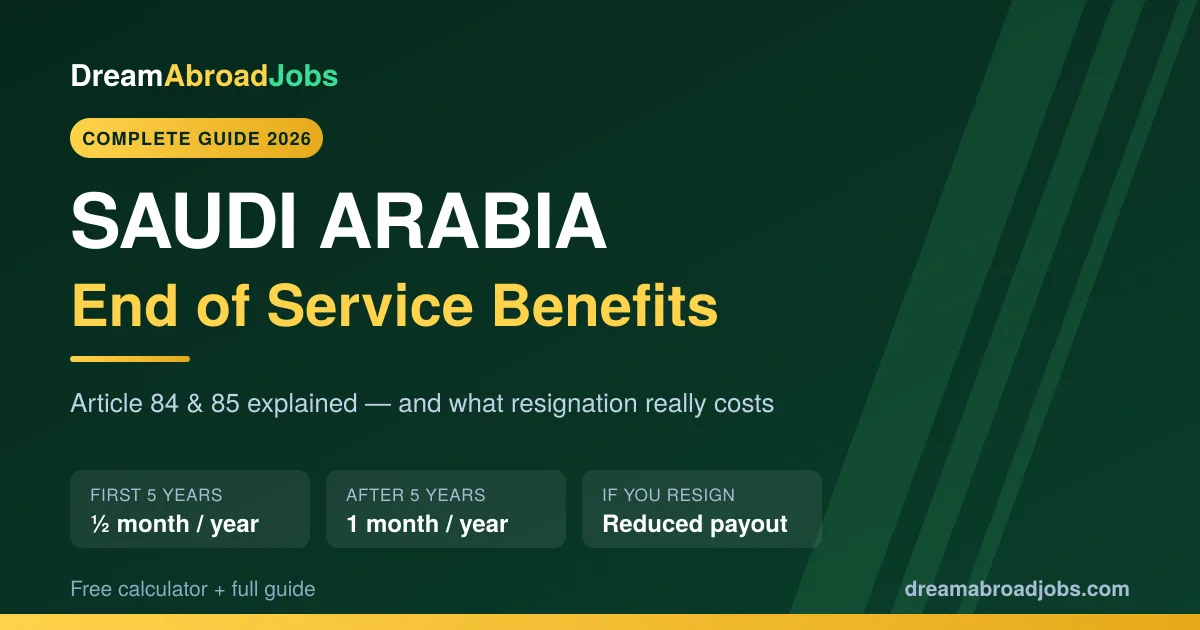
- First 5 years: half a month's wage per year
- Year 6 onwards: one full month's wage per year
Partial years count proportionally. Someone with 7 years and 6 months earns for exactly that, not 7 years.
Unlike the UAE, there is no maximum cap on Saudi ESB. A 25-year employee keeps accruing a full month per year with no ceiling.
Worked example — termination
An employee on a wage of SAR 8,000 who worked 8 years and was terminated:
First 5 years: 0.5 × 5 × 8,000 = SAR 20,000
Years 6 to 8: 1 × 3 × 8,000 = SAR 24,000
Total ESB = SAR 44,000
You can run your own numbers on our Saudi end-of-service calculator.
The resignation tiers (Article 85) — read this part carefully
Here is where Saudi Arabia differs sharply from the UAE. In the UAE, the resignation penalty was abolished in February 2022. In Saudi Arabia it still exists.
If you resign, your calculated ESB is reduced according to how long you served:
| Years of serviceWhat you receive on resignation | |
| Under 2 years | Nothing |
| 2 to under 5 years | One third of the calculated ESB |
| 5 to under 10 years | Two thirds of the calculated ESB |
| 10 years or more | The full amount |
Take the same SAR 44,000 from the example above. If that employee had resigned at 8 years instead of being terminated, they would receive two thirds — roughly SAR 29,333. A difference of nearly SAR 15,000 for the same eight years of work.
If you are close to a tier boundary, the maths is worth doing before you hand in your notice. Someone resigning at 4 years and 10 months gets one third. Two months later, they get two thirds. Someone at 9 years and 8 months gets two thirds; four months later, they get everything.
If you are terminated, no reduction applies
Redundancy, restructuring, contract expiry, or any employer-side ending other than gross misconduct means you receive the full Article 84 amount. Even a short-service employee who is terminated gets their full calculated figure — small, but not reduced.
The exceptions where you get 100% anyway
Article 87 and related provisions protect certain situations. You receive the full ESB with no resignation reduction if:
- Your service ends due to force majeure — circumstances outside your control
- You are a female employee resigning within 6 months of marriage, or within 3 months of giving birth
- You resign because the employer breached the contract under Article 81 — for example non-payment of wages, or assault
- You reach retirement age
That Article 81 route matters more than people realise. If your employer stopped paying you and you resigned as a result, that is not an ordinary resignation, and the Article 85 reduction should not be applied to you. Keep evidence — unpaid payslips, WPS records, written complaints.
Which wage does the calculation use?
This is the second big difference from the UAE, and it works in your favour.
The Labour Law bases ESB on your last wage. Under the law's own definition, "wage" means the basic salary plus regular fixed allowances such as housing and transport — not basic alone.
Compare the two countries on the same package:
| UAESaudi Arabia | ||
| Calculation base | Basic salary only | Last wage (basic + fixed allowances) |
| Resignation penalty | None since Feb 2022 | Yes — Article 85 tiers |
| Minimum service | 1 year | 2 years (for resignation) |
| Maximum cap | 2 years' basic salary | No cap |
In practice, some Saudi employers still calculate on basic alone. If your contract clearly separates a housing allowance that you receive every month without variation, that is a fixed allowance and there is a strong argument it belongs in the wage. Check your contract wording and ask HR in writing which base they used.
Our UAE gratuity calculator and Qatar gratuity calculator apply each country's own rules, so do not reuse a figure from one country in another.
When you can lose ESB entirely
Article 80 lists the grounds for dismissal without notice, compensation, or ESB. These are serious — forgery, assault, disclosing trade secrets, deliberate material damage, prolonged unexplained absence.
An employer who withholds your ESB has to point to a specific Article 80 ground. Dissatisfaction with your performance is not one of them, and neither is a dispute with your manager.
Getting paid — the practical part
Your final settlement is normally due within a short window of your last working day. Before you sign anything:
- Ask for the calculation in writing — the wage figure used, the years counted, whether an Article 85 reduction was applied, and why.
- Check the reason for leaving on the paperwork. If you were terminated but the exit form says "resignation", that single word can cut your payment by a third. This happens more often than it should.
- Cross-check on the official tools. The Ministry of Human Resources and Social Development (MHRSD) and the Qiwa platform both offer official calculators.
- File a labour complaint through Qiwa or MHRSD if there is a genuine gap. The process is free for workers, and the Labour Courts handle unresolved cases.
Do not sign a final clearance or quittance document until you have checked the figure. Once signed, challenging it becomes much harder.
What ESB is not
ESB is separate from GOSI. Your GOSI contributions build a pension entitlement; ESB is a one-time payment from your employer. Receiving one does not affect the other, and an employer cannot offset ESB against GOSI.
ESB is also separate from unused annual leave, unpaid overtime, and your final salary. All of those should appear as their own lines on your settlement.
Before you resign — a short checklist
- Work out which Article 85 tier you are in, and how close you are to the next one
- Confirm in writing which wage figure your employer will use
- Check that no unpaid leave has been wrongly recorded against your service period
- If you are leaving because of an employer breach, document it before you resign
- Keep copies of your contract, payslips and any amendment letters
Frequently asked questions
Do I get ESB if I resign in Saudi Arabia?
Yes, but reduced — one third between 2 and 5 years, two thirds between 5 and 10 years, and the full amount at 10 years or more. Under 2 years, resignation earns nothing.
Is Saudi ESB calculated on basic salary only?
No. The law uses your last wage, which includes basic salary plus regular fixed allowances such as housing and transport. This differs from the UAE, where only basic salary counts.
Is there a maximum ESB in Saudi Arabia?
No. Unlike the UAE's two-year cap, Saudi ESB has no ceiling.
What if I am terminated instead of resigning?
You receive the full Article 84 amount with no reduction, regardless of length of service.
Do women have special rules?
Yes. A female employee who resigns within 6 months of marriage or within 3 months of giving birth receives her full ESB with no reduction.
Does ESB replace my GOSI pension?
No. They are entirely separate entitlements.
Work out your own figure
The formula is manageable by hand, but the resignation tiers and partial years are where mistakes creep in. Run your numbers through our free Saudi end-of-service calculator and compare the result against whatever your employer produces.
If your next move is elsewhere in the Gulf, our UAE gratuity calculator and Qatar gratuity calculator cover those rules, and you can browse current jobs in Saudi Arabia updated daily. Your work permit classification (High-Skilled, Skilled, or Basic) matters just as much while you're still working — see our guide to Saudi work permit classification 2026.
This guide explains the general position under the Saudi Labour Law and is not legal advice. For a dispute about your own settlement, contact MHRSD, use the Qiwa platform, or consult a licensed Saudi employment lawyer.